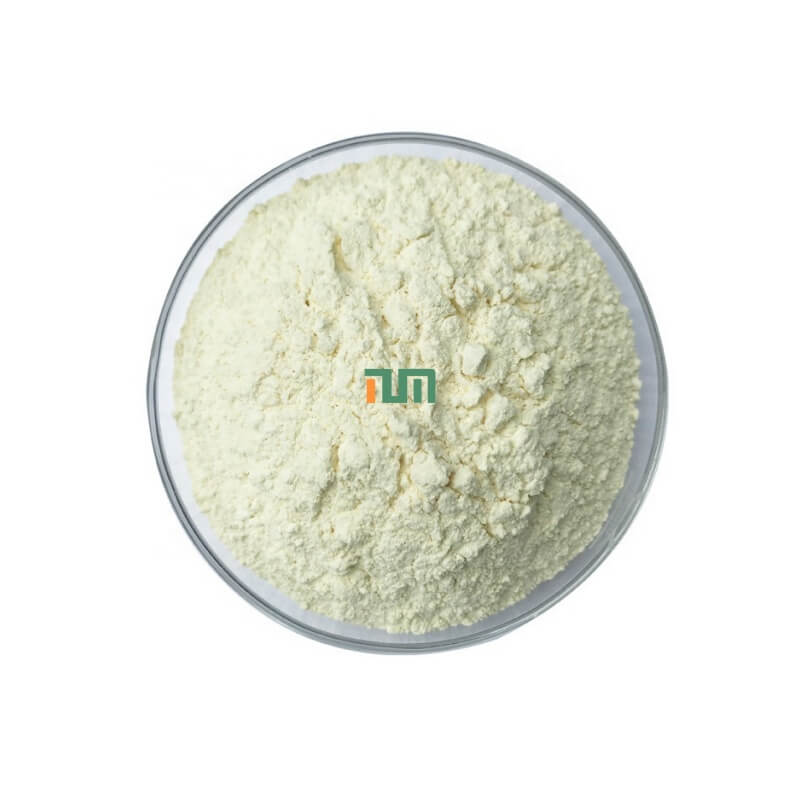
Ectoin has become an increasingly recognized ingredient in modern skincare formulations, particularly in products positioned around hydration, skin barrier support, and environmental-stress care. For cosmetic manufacturers and formulation teams, its value goes beyond being a trending skincare ingredient. Ectoin offers a distinctive approach to formulation development based on its ability to interact with water and support the stability of biological structures under challenging environmental conditions.
As demand grows for barrier-focused and multifunctional skincare products, Ectoin is being considered for a wider range of cosmetic formats, including serums, creams, moisturizers, toners, and other leave-on formulations.
This article examines what Ectoin is, how it is used in skincare, its formulation value, and how it can complement other commonly used cosmetic ingredients.
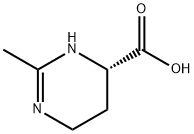 Ectoin Cas 96702-03-3
What Is Ectoin?
Ectoin(Cas 96702-03-3) is a small organic compound known as an extremolyte. Certain microorganisms naturally produce extremolytes as part of their adaptation to demanding environmental conditions such as high salinity, dehydration, temperature changes, and other forms of environmental stress.
From a cosmetic formulation perspective, Ectoin is particularly interesting because of its interaction with water and its association with the stabilization of proteins and biological membranes. These characteristics have contributed to research into its potential role in maintaining skin hydration and supporting the skin barrier.
Ectoin is also commonly referred to as Ectoine. For cosmetic ingredient searches, both terms may appear in technical literature, product databases, and formulation discussions.
For ingredient developers, the key point is that Ectoin is not simply another conventional moisturizing ingredient. Its functional positioning is connected to water management, cellular structure stabilization, and the development of formulations designed for dry, sensitive, or environmentally stressed skin.
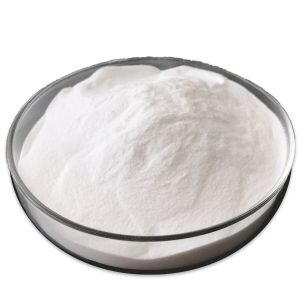 Ectoine Raw Materials
How Does Ectoin Work in Skincare?
The interest in Ectoin comes largely from its interaction with water and biological structures.
Ectoin can organize water molecules around itself, creating a hydrated environment that has been investigated for its role in protecting biological structures from environmental stress. This mechanism has led researchers to investigate Ectoin in topical formulations intended to support hydration and skin barrier function.
For cosmetic formulation development, several aspects are particularly relevant.
1. Water Interaction and Hydration
Ectoin has a strong interaction with water molecules. This property is important when developing skincare products where maintaining a hydrated skin environment is part of the product concept.
Rather than functioning only as a conventional humectant, Ectoin is generally discussed in relation to the organization of water around biological structures. Research on topical Ectoine formulations has examined changes related to skin hydration and transepidermal water loss, although outcomes can vary according to the formulation and study design.
2. Skin Barrier Support
The skin barrier is a major focus of modern skincare development. A well-functioning barrier helps maintain an appropriate moisture balance and provides a protective interface between the skin and its surrounding environment.
Ectoin has been investigated for its potential role in supporting barrier-related properties through hydration and stabilization mechanisms. This makes it relevant to cosmetic products designed around barrier-support concepts.
3. Support Under Environmental Stress
Ectoin’s biological origin provides an interesting foundation for its use in skincare. Extremolytes are produced by microorganisms that must survive under challenging environmental conditions.
In cosmetic formulation discussions, this property has led to interest in Ectoin for products designed to help maintain skin comfort and hydration when the skin is exposed to environmental stressors.
However, Ectoin should be viewed as a supporting cosmetic ingredient rather than a substitute for dedicated UV filters or other specifically regulated functional ingredients.
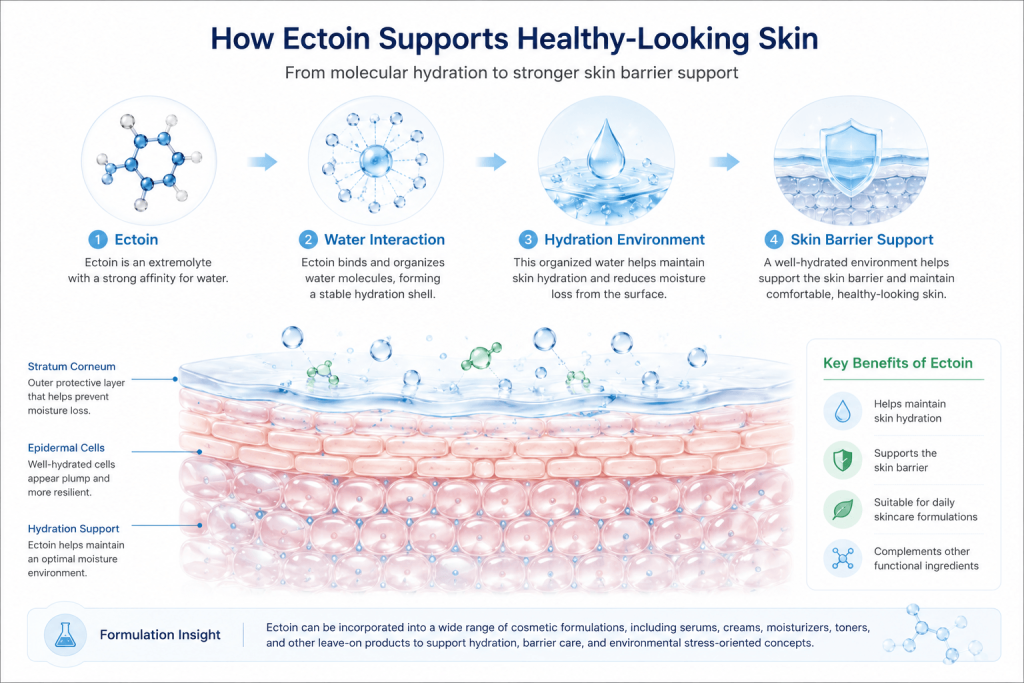
Ectoin Skin Benefits
The growing interest in Ectoin skincare is closely related to several formulation benefits associated with hydration and barrier-focused product development.
1. Hydration Support
Ectoin is frequently incorporated into skincare concepts focused on maintaining skin hydration. Its interaction with water makes it particularly interesting for formulations designed for dry or dehydrated-feeling skin.
For formulators, this provides an opportunity to position Ectoin alongside other hydration-focused ingredients rather than relying on a single ingredient to achieve the overall sensory and functional profile of a product.
2. Skin Barrier Support
Barrier-focused skincare has become an important direction in cosmetic formulation. Ectoin can contribute to formulations designed around skin barrier support through its hydration-related and stabilization properties.
This positioning is particularly relevant for creams, serums, emulsions, and other leave-on products where maintaining skin comfort and moisture balance is a key formulation objective.
3. Suitable for Sensitive-Skin Formulation Concepts
Ectoin is increasingly found in products positioned for dry, sensitive, or easily stressed skin. Its use in this area is related to its hydration and barrier-support positioning.
For manufacturers, Ectoin can therefore be considered when developing formulations that emphasize gentle skincare, moisture retention, and skin comfort.
The finished product’s suitability for sensitive skin will, however, depend on the complete formulation rather than Ectoin alone.
4. Environmental-Stress-Oriented Skincare
Modern skincare development increasingly considers environmental factors as part of daily skin maintenance. Formulators may therefore combine hydration, barrier support, and environmental-stress positioning within the same product concept.
Ectoin is relevant to this approach because its biological function is associated with protection from harsh environmental conditions. This provides a scientifically interesting foundation for cosmetic formulation development.
5. Multifunctional Formulation Value
One of the practical advantages of Ectoin is that it can fit into several formulation concepts at the same time.
A single formulation may use Ectoin as part of a broader strategy involving hydration, barrier support, and skin-conditioning properties.
This multifunctional positioning can be useful when developing streamlined ingredient systems for modern skincare products.
Ectoin vs. Other Skincare Ingredients
Ectoin is sometimes compared with familiar ingredients such as hyaluronic acid and ceramides. These ingredients can overlap in certain product concepts, but they do not serve exactly the same formulation role.
| Ingredient | Typical formulation focus |
|---|---|
| Ectoin | Hydration support, barrier-focused formulations, environmental-stress positioning |
| Ceramides | Skin-lipid and barrier-focused formulations |
| Hyaluronic Acid | Hydration and water-binding applications |
| Phytosphingosine | Skin-conditioning and lipid/barrier-oriented formulations |
| Squalane | Emollience, skin conditioning, and sensory improvement |
1. Ectoin vs. Hyaluronic Acid
Ectoin and Hyaluronic Acid can both appear in hydration-focused skincare products, but their formulation roles are different.
Hyaluronic Acid is widely used as a water-binding polymer in cosmetic formulations, while Ectoin’s positioning is associated with its interaction with water and stabilization of biological structures.
For this reason, the two ingredients can be complementary rather than mutually exclusive.
2. Ectoin vs. Ceramides
Ceramides are important components of the skin’s lipid barrier and are widely used in barrier-oriented cosmetic formulations.
Ectoin operates through a different mechanism and can therefore be considered alongside ceramides when developing multifunctional barrier-support products.
A formulation containing both types of ingredients may address different aspects of hydration and barrier-focused product development.
3. Ectoin vs. Phytosphingosine
Phytosphingosine is associated with skin lipid systems and is used in a range of barrier-oriented cosmetic formulations.
Ectoin provides a different formulation approach based on hydration and stabilization. Combining ingredients with complementary functions can be useful when the goal is to develop a more comprehensive skincare concept.
Ectoin in Cosmetic Formulations
Ectoin can be considered for a range of cosmetic formulation formats. The most appropriate application depends on the formulation system, product positioning, ingredient compatibility, and required sensory characteristics.
1. Ectoin in Serums
Serums provide a suitable format for concentrated ingredient concepts and lightweight hydration systems.
Ectoin can be incorporated into serum formulations designed around hydration and skin barrier support. It may also be combined with other water-compatible ingredients to create multifunctional skincare systems.
2. Ectoin in Creams and Moisturizers
Creams and moisturizers offer a broader formulation environment because they can combine water-phase ingredients with emollients, lipids, and emulsifiers.
Ectoin can be incorporated into formulations where hydration and barrier support are important positioning points. It can also be used alongside lipid-oriented ingredients to create a more comprehensive barrier-care concept.
3. Ectoin in Toners and Essences
Lightweight toners and essences are increasingly used as hydration-focused products.
Ectoin can be considered in these formulations when the product concept emphasizes hydration and skin comfort without creating a heavy sensory profile.
The final performance will depend on the complete ingredient system, including solvents, humectants, polymers, preservatives, and other functional ingredients.
4. Ectoin in Barrier-Support Products
Barrier-focused skincare is one of the most relevant application areas for Ectoin.
Products in this category may combine Ectoin with ingredients that provide complementary functions, such as ceramides, hyaluronic acid, phytosphingosine, or emollient materials.
Rather than replacing these ingredients, Ectoin can be positioned as one component within a broader formulation strategy.
5. Ectoin in Sensitive-Skin Products
Ectoin is also relevant to cosmetic products developed for dry or sensitive-skin positioning.
When used in these products, the complete formulation should be evaluated for compatibility, sensory properties, preservation, and overall skin tolerance. Ectoin itself should not be treated as a guarantee of finished-product suitability.
Why Is Ectoin Gaining Attention in Skincare?
The growth of Ectoin in skincare reflects a broader shift toward multifunctional and barrier-focused cosmetic formulations.
Consumers are increasingly familiar with concepts such as skin hydration and barrier care, while cosmetic manufacturers are looking for ingredients that can support several product-positioning objectives without unnecessarily complicating the formulation.
Ectoin fits into this development direction because it can be discussed from several technical perspectives:
- Hydration support
- Skin barrier support
- Environmental-stress-oriented skincare
- Sensitive-skin formulation concepts
- Multifunctional cosmetic formulations
This makes Ectoin relevant not only to finished-product brands but also to cosmetic formulators, R&D teams, ingredient distributors, and manufacturers developing new skincare products.
The increasing presence of Ectoin in modern skincare also creates opportunities for formulation differentiation. Rather than presenting Ectoin simply as a trending ingredient, manufacturers can incorporate it into products built around specific formulation concepts such as barrier care, hydration, or daily environmental-stress support.
Can Ectoin Be Combined With Other Skincare Ingredients?
Ectoin can be evaluated alongside a variety of commonly used cosmetic ingredients.
For example, a formulation may combine Ectoin with Hyaluronic Acid for a broader hydration concept, or with ceramides and other lipid-oriented ingredients for a barrier-focused formulation.
The actual compatibility of the complete ingredient system should always be verified through formulation testing.
This is particularly important when a product contains multiple active ingredients, polymers, preservatives, electrolytes, or other components that may influence stability or sensory properties.
Ectoin for Cosmetic Formulation Development
Ectoin is becoming a relevant ingredient for cosmetic manufacturers developing modern skincare products focused on hydration, barrier support, and environmental-stress-oriented care.
Its value lies not only in current skincare interest but also in its distinctive formulation profile and potential compatibility with broader ingredient systems. For R&D teams, the most effective approach is to evaluate Ectoin as part of the complete formulation rather than as an isolated claim ingredient.
Natural Micron Pharm supplies Ectoine (CAS 96702-03-3) for cosmetic ingredient applications. Our Ectoine raw material is listed with a 98% specification and is available for formulation development and B2B sourcing.
For product specifications, COA, SDS, samples, quotation, or technical information, please contact our team to discuss your formulation requirements.
Explore our Ectoine cosmetic ingredient!
FAQ
Q1. What is Ectoin?
Ectoin is a small organic compound known as an extremolyte. It is produced by certain microorganisms as part of their adaptation to demanding environmental conditions. In cosmetics, Ectoin is mainly studied and used in formulations focused on hydration, skin barrier support, and environmental-stress-oriented skincare.
Q2. What does Ectoin do for skin?
Ectoin is primarily associated with hydration support and skin barrier-focused formulation concepts. Its interaction with water and biological structures has made it an interesting ingredient for products designed around moisture balance and skin comfort.
Q3. Is Ectoin good for sensitive skin formulations?
Ectoin is commonly used in cosmetic products positioned for dry or sensitive skin. However, the suitability of a finished product depends on the complete formulation, concentration, processing conditions, and other ingredients rather than Ectoin alone.
Q4. What should cosmetic manufacturers consider when sourcing Ectoin?
Manufacturers should evaluate raw material identity, purity or assay, appearance, batch consistency, documentation, packaging, storage requirements, and compatibility with the intended formulation. Technical documents such as a COA and SDS can also support the raw material evaluation process.